AFM probe interaction with molecules covered soft sample (animation)
Ringing Mode AFM Extension
Advantages of Ringing Mode™
Ringing Mode™ produces a quantitative level of imaging. Imaging of topography and compositional properties of sample material down to the nanoscale.
For Bruker AFMs, these 8 new Ringing Mode™ data channels are obtained simultaneously with the 6 PeakForce QNM® channels. Together, this expands the total available channels to 14 different data types and provides a very rich data set.
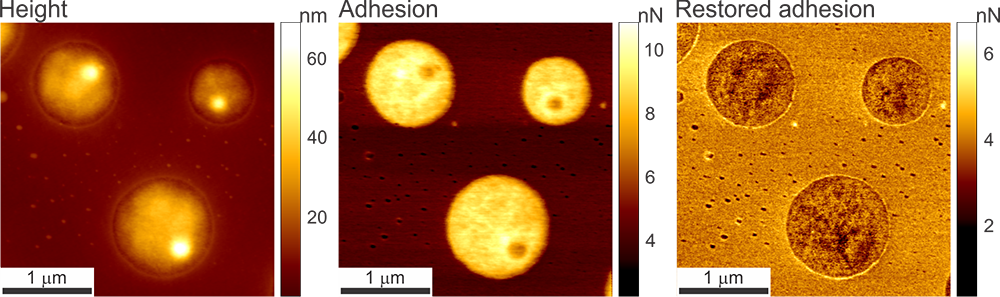
Restored Adhesion
After pull-off (point D in Figure 2), the AFM cantilever bounces off the surface, and creates a high pitch ringing sound. With each oscillation the amplitude of the sound is reduced due to dissipation. When the quality factor is known (can be measured separately), one can extrapolate the value of the adhesion force to the moment of pull-off or, more precisely, to the time when the extrapolation curve crosses the deflection curve. This is shown in Figure 2 as point E (restored adhesion, not yet averaged). Because the measured values of the cantilever deflection have an intrinsic noise, it is advantageous to calculate restored adhesion using multiple points of the ringing signal and, subsequently, to average the obtained values in order to produce a higher degree of accuracy in the measured value of the restored adhesion (restored averaged adhesion). In other words, the difference between the restored and regular adhesion comes from both a smooth disconnection (necking) of the AFM probe from a sample surface and molecular tails detaching from the AFM probe after it has lost the adhesive contact with the sample surface. In the case of this PS-LDPE sample, the Adhesion channel indicates that the LPDE domains adhere more strongly to the probe tip. The comparison of the Restored Adhesion and regular adhesion indicates that LPDE requires more energy during the pull off than PS.
Adhesion height
The position of the sample at the maximum negative deflection of the cantilever, where the force is equal to the force of adhesion (point D in Figure 2). For the image see quadrant 3 on Figure 3.
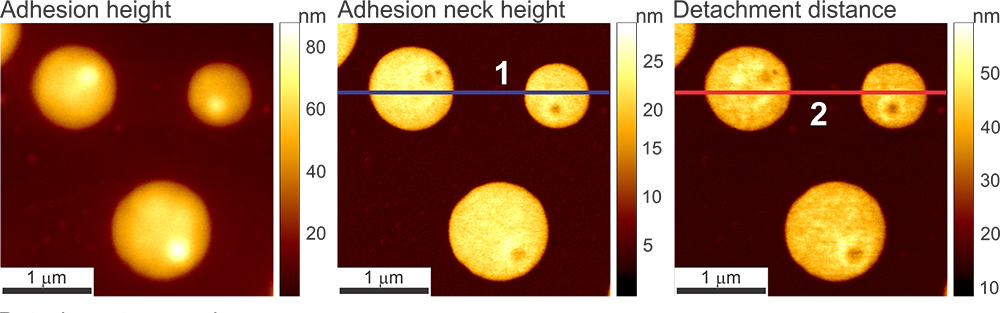
Physical channels independently showing substantial differences between these two measurements on a PS/LDPE sample. Non-uniform detachment as molecules break free from tip (difference between E & F after cantilever goes through max downward deflection, ringing does not begin yet. By making this distinction, RM detects the subtle difference)
Zero-force height
The position of the sample when the load force (the cantilever deflection) is zero, (points B, B* in the Figure 2). For the image see quadrant 2 on Figure 3.
A comparison of all these 3 heights and the regular AFM height is shown in the figure below.
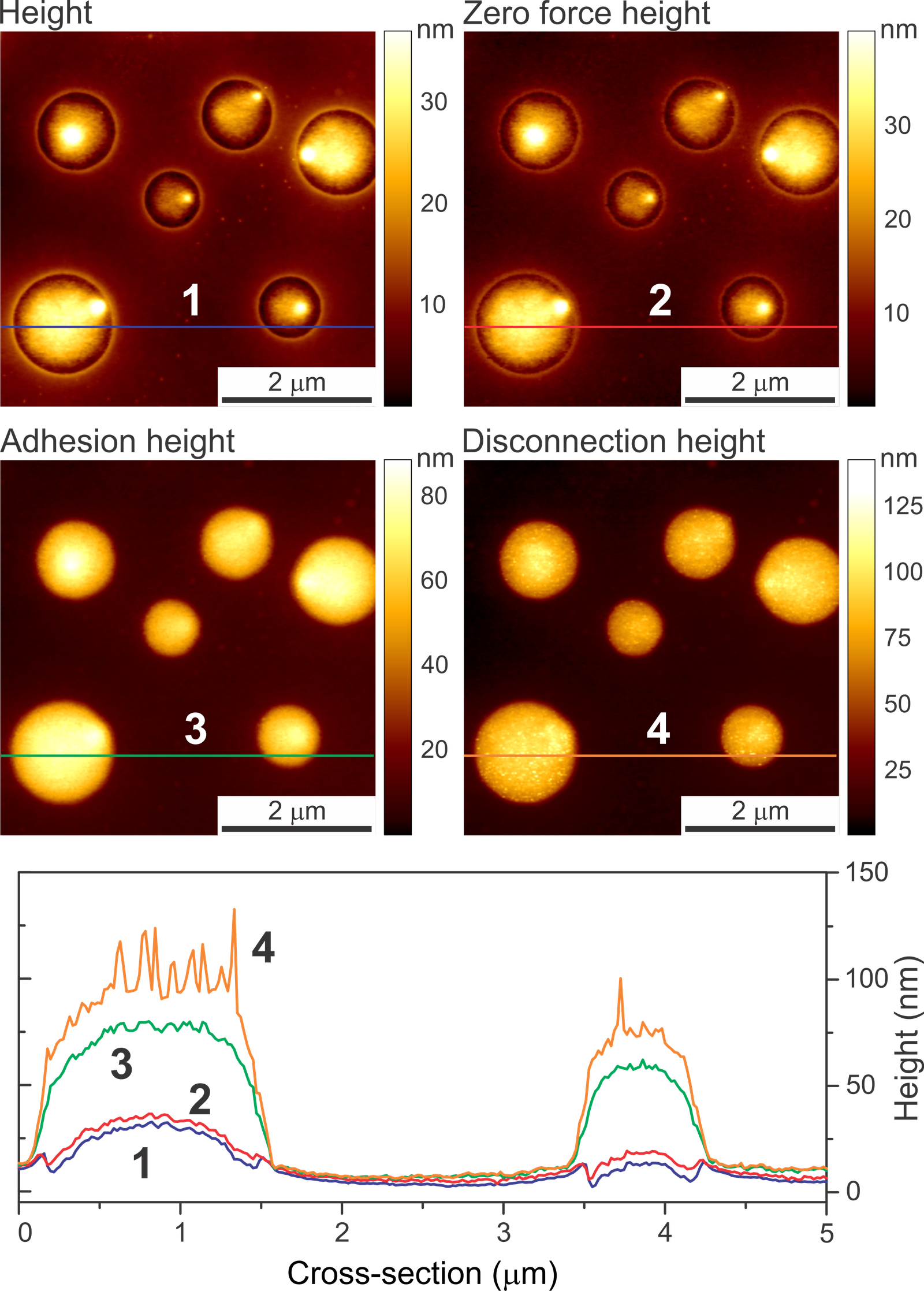 Figure 3
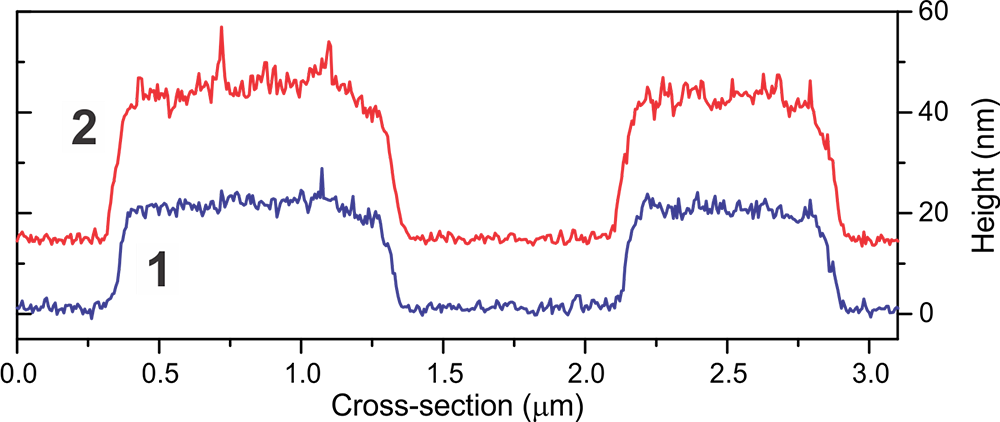
The figure shows an example of simultaneous imaging of four different heights: (a) regular, (b) zero force, (c) adhesion, and (d) disconnection heights. The cross-sectional lines shown in the images are presented in panel (e). All images collected on a Bruker calibration sample, a blend of two polymers, low density polyethylene and polystyrene. The scan rate of 1 Hz (1 sec per line) is used.
Disconnection height
The position of the sample when the force is equal to the force of restored adhesion (point E in Figure 2). For the image see quadrant 4 on Figure 3.
Pull-off neck size
The height of the neck between the AFM probe and sample surface created by the adhesive action of the probe at the moment of pull-off, parameter Δ in the Figure 2. See animation to visualize the pull-off neck height. By measuring the maximum height of the neck as material is pulled from the sample surface by the AFM tip during probe retraction, Ringing Mode can provide insights into processes such as polymer necking or lipid membrane tubule formation in cells. This extends the mechanical property information already provided by PeakForce QNM and any sub-resonant tapping mode, to provide further quantification of viscous deformation at the nanoscale.
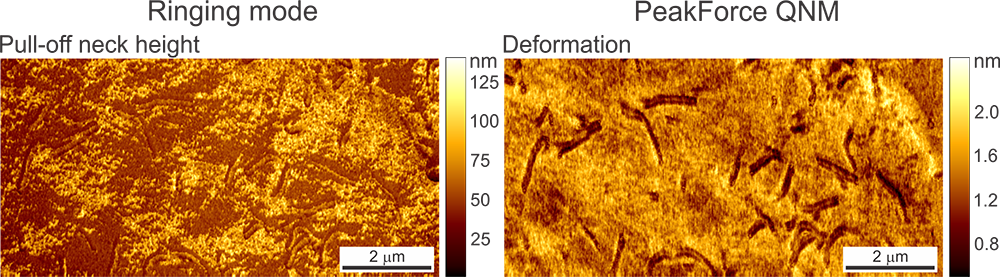
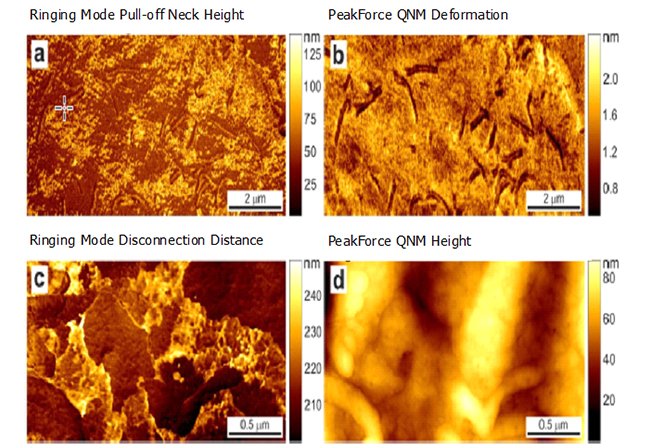
Images obtained on a human melanoma cell. Bright areas in the Pull-off Neck Size data channel indicate areas of the cell membrane that form a longer, more stable neck between the AFM tip during pull-off.
Disconnection distance (the length of molecules pulled by the AFM probe during retraction)
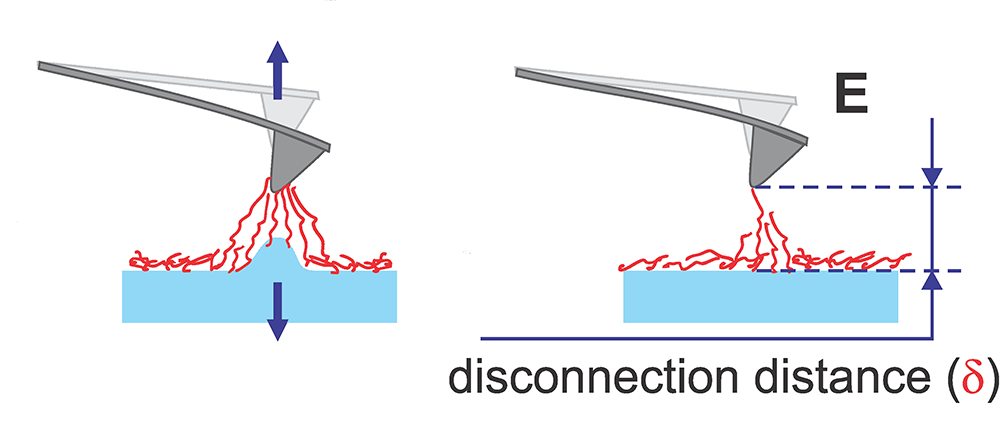
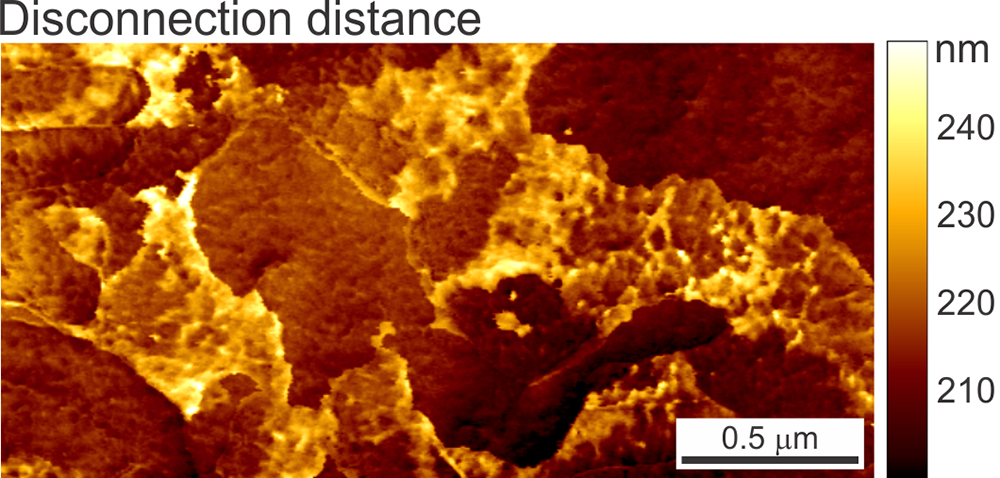
The height of the molecular asperities/molecules stretched by the AFM probe, parameter δ in Figure 2. Ringing Mode successfully measures the length of molecules that are stretched from the surface by the AFM probe, such as those found in polymer coatings or cell membranes. These nanoscale maps can provide key information as to the surface distribution and organization of soft, flexible molecules that are not easily imaged by other techniques. See animation to visualize the disconnection distance.
Disconnection energy loss
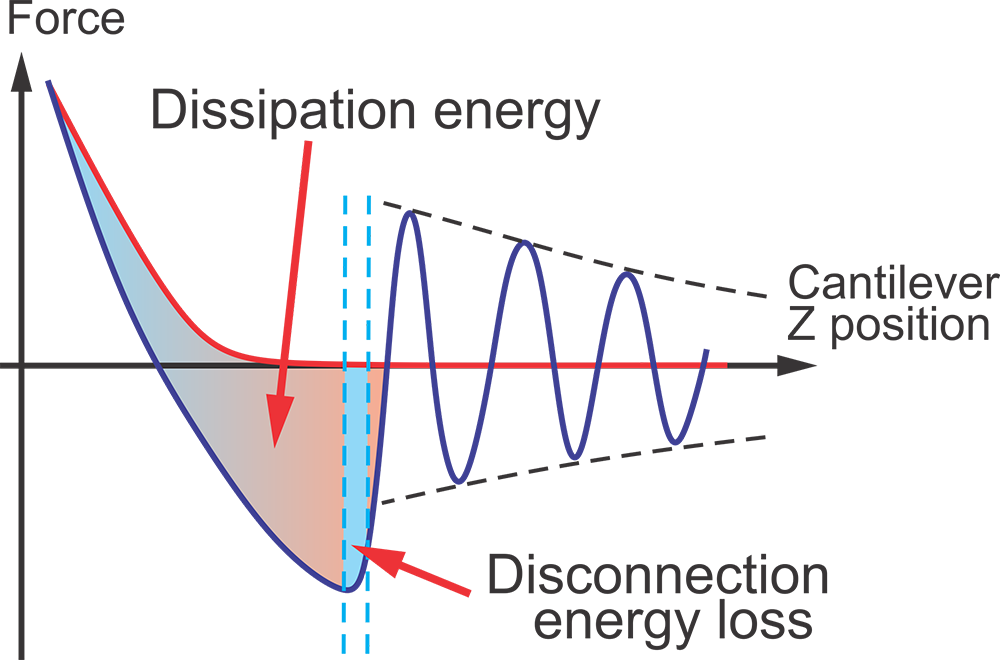
Energy losses due to dissipation after disconnection of the AFM probe from the sample surface. This energy loss comes from the energy of the viscoelastic pull of the sample material under the probe and from rupturing the molecular contacts between the probe and sample. The latter can include the breakage of water meniscus if the scanning is done in air. A graphical comparison of the disconnection energy loss and a traditional dissipation energy channel is shown in the figure below.
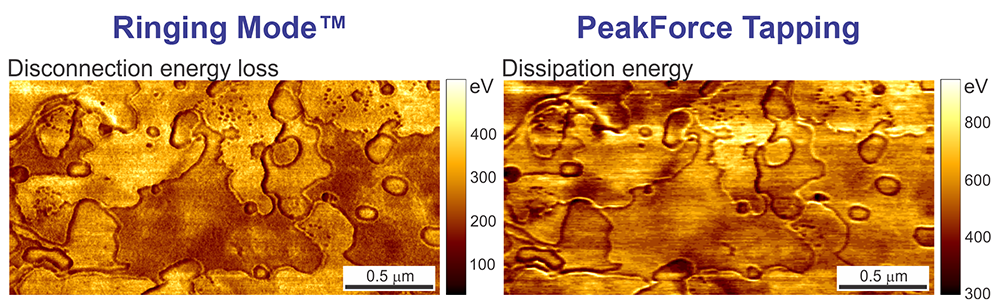
The images below depict the disconnection energy loss measured on a sample of corneocytes as well as the regular energy dissipation channel from PeakForce QNM measured on the same sample. One can see a substantial difference between these two images. PeakForce QNM Dissipation Energy provides the sum of all energy contributions during interaction of the AFM with the sample surface. This includes energy dissipated due to (1) the adhesion energy, (2) the energy due to the viscous response of the sample material during the contact deformation, and finally, (3) the disconnection energy loss. Ringing Mode separately measures Disconnection Energy Loss.
Dynamic creep phase shift
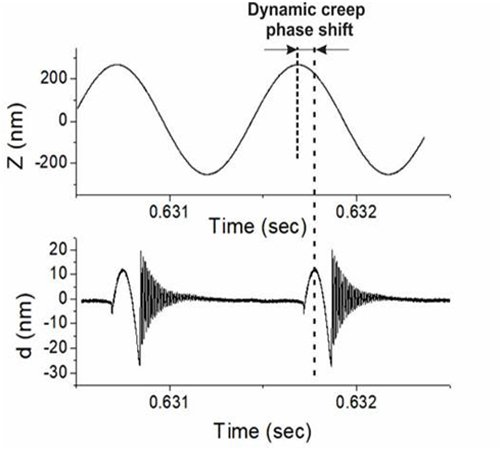
The phase difference between the oscillation of the sample and AFM cantilever. A graphical definition of the dynamic creep phase shift is shown in the figure below.
 Examples of the new data channels
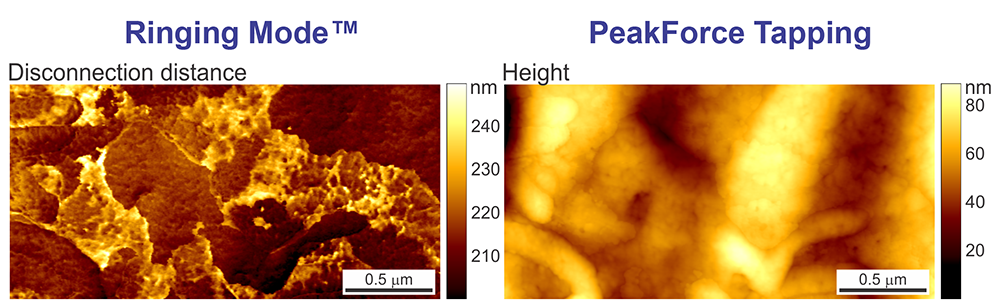
A principally new imaging channel of the Ringing Mode™ — disconnection distance. The cell height is shown as a reference (simultaneously recorded in PeakForce Tapping® mode). The scan rate is 0.5 Hz. An example of a human melanoma cell is shown.
Examples of the new data channels
A principally new imaging channel of the Ringing Mode™ — disconnection distance. The cell height is shown as a reference (simultaneously recorded in PeakForce Tapping® mode). The scan rate is 0.5 Hz. An example of a human melanoma cell is shown.
 The human skin flake sample imaged at 1 Hz (1 sec per line). The disconnection energy loss (the energy loss during the separation of the AFM probe from the sample surface) and the dissipation energy (imaged using PeakForce Tapping®) are shown.
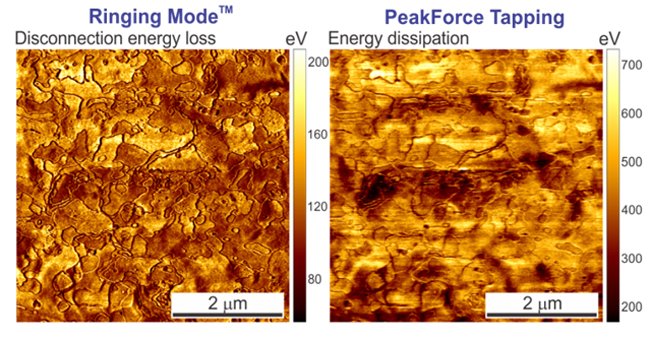
Examples of the new data channels
A principally new imaging channel of the Ringing Mode™ — disconnection distance. The cell height is shown as a reference (simultaneously recorded in PeakForce Tapping® mode). The scan rate is 0.5 Hz. An example of a human melanoma cell is shown.
Disconnection distance
The human skin flake sample imaged at 1 Hz (1 sec per line). The disconnection energy loss (the energy loss during the separation of the AFM probe from the sample surface) and the dissipation energy (imaged using PeakForce Tapping®) are shown.
Disconnection energy loss
A few examples of scanning in water
LDPE/PS blend in water:

The surface of polystyrene in water:

RM can go faster than regular/standard resonant tapping mode and also provides new information channels/data lacking in TM. A two-polymer blend is imaged in Ringing Mode™ below at scan speeds ranging from 0.25 Hz to 5Hz. Even at increased scan rates, the adhesion images remain artifact-free. These adhesion data channel types are not available with standard resonant tapping modes.


Compared to existing state of art AFM technology, Ringing Mode™ enables substantially higher resolution imaging of the surface of soft samples. This is due to minimization of tip-sample contact size that happens at the disconnection point.
The images below depict the height of a human melanoma cell surface. The image on the left displays adhesion height recorded with Ringing Mode™ while the image on the right presents height recorded with standard imaging modes. The radii of the curvature of the adhesion and standard heights demonstrate the most frequent values observed in both height images.


The proprietary algorithm identifies and removes interference artifacts while maintaining the values of measured physical parameters (alteration of values is a common problem with existing filters). Since the ringing occurs at the zero deflection point of the cantilever, the background shift (the cause of the artifact resulting from interference) is easily identified and subsequently corrected.
Because the ringing curve contains multiple measurements/data points, the information can be averaged, resulting in a substantial decrease in noise when defining adhesion. We call this parameter “averaged restored adhesion”, or just “restored adhesion”.

What is ringing mode?

Figure 1
Ringing Mode™ is an extension of sub-resonance tapping modes. It allows for 8 new channels of previously inaccessible physical sample properties to be acquired at the same time. These new channels expand the existing 6 standard sub-resonance image channels to simultaneously provide up to 14 different and complementary data types.
Ringing Mode™ provides new approach for viewing polymers and biomaterials.
NSS has demonstrated successful operation of Ringing Mode™ for imaging in air and in fluid.
Ringing Mode™ utilizes a portion of the signal received from the AFM cantilever, which was previously regarded as noise, and consequently, filtered out or just ignored. A typical unfiltered signal of an AFM cantilever deflection as a function of time is shown in the figure above. Ringing Mode™ is a combination of an oscillatory non-resonant mode along with a resonant one. It operates with non-resonant feedback while utilizing signal information from the ringing of the AFM cantilever. Such ringing of the cantilever occurs after detaching of the AFM probe from a sample surface due to free resonance oscillations.
A schematic of the signal exploited in Ringing Mode
The analysis of all signals used to derive the information visualized in ringing mode is presented in the figure below.
 Figure 2
The cantilever deflection d and vertical position of the AFM scanner Z versus time are shown.
a. One full cycle of 1 kHz vertical oscillation of the Z scanner is presented. A typical unfiltered signal of the cantilever deflection d(or force = kd, where kis the spring constant of the cantilever) as a function of time is shown. The dashed lines show the decrease of the oscillating amplitude of the AFM cantilever due to dissipation. Positive values of the cantilever deflection d are due to forces of repulsion, and vice versa, and negative values stand for the attraction between the AFM probe and sample surface. Specific points during the cantilever motion indicate the following probe positions: (A) far from the sample surface, (B) touches the sample, (C) deforms the sample surface, (B*) touches the surface with zero force when retracting, (D) starts a fast detachment (pull-off) from the sample (the point defining adhesion force), (E) completely detaches from the sample (the point defining the restored adhesion force), (F) starts free oscillations above the sample surface.
b. Neck height Δ is defined as the size of the neck of the pull-off deformation caused by the AFM probe right before disconnection from the surface; disconnection distance δ is defined as the size of the molecular tails pulled from the surface by the AFM probe during the disconnection from the sample surface.